
Cationic Yarn Curtain Fabric manufacturers take you to understand the characteristics of cationic fabrics
Release time:
2022-07-20 14:35
Cationic Yarn Curtain Fabric manufacturers tell you that cationic fabrics are all polyester fabrics. Generally, cationic yarn is used in the warp direction, and ordinary polyester yarn is used in the weft direction. Sometimes, in order to achieve a better linen-like effect, polyester and cationic two-component fibers are blended. When dyeing, dyes are also used separately, common dyes are used for polyester yarn, and cationic dyes are used for cationic yarn. The effect of the cloth surface will have a two-color effect.
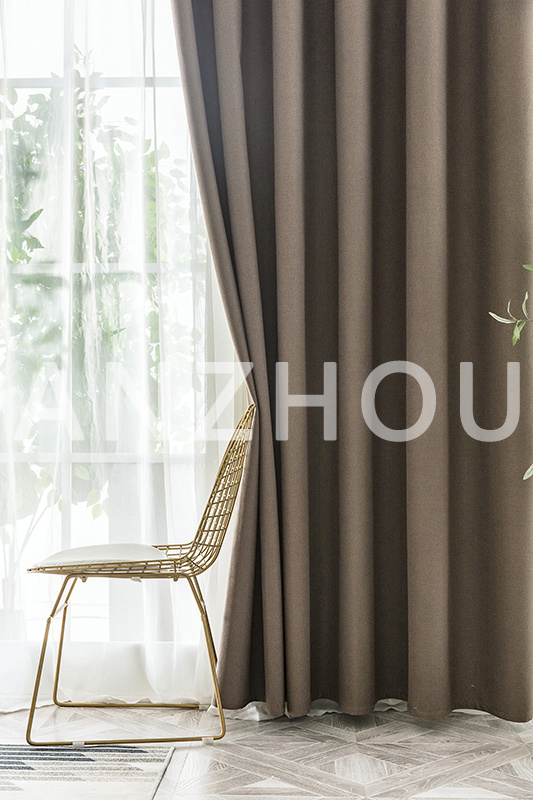
Features of cationic fabrics:
1. The manufacturer of Cationic Yarn Curtain Fabric tells you that one of the characteristics of cationic fabrics is the two-color effect. Using this feature, some yarn-dyed two-color fabrics can be replaced, thereby reducing the cost of the fabric. This is the characteristic of cationic fabrics, but also Limiting its characteristics, in the face of multi-color yarn-dyed fabrics, cationic fabrics can only be replaced.
2. The cationic fabric has bright color and is very suitable for artificial fibers, but the color fastness to washing and light fastness of natural cellulose and protein fabrics is very poor.
3. Cationic Yarn Curtain Fabric manufacturers tell you that the wear resistance of cationic fabrics is also very good. After adding some artificial fibers such as polyester and spandex, the strength is higher, the elasticity is better, and the wear resistance is second only to nylon.
4. Cationic Yarn Curtain Fabric manufacturers tell you that cationic fabrics have some chemical properties, such as corrosion resistance, dilute alkali resistance, bleach resistance, oxidant resistance, hydrocarbons, ketones, petroleum products and inorganic acids, as well as some physical properties, such as UV resistance.
Recommended news
CONTACT INFORMATION
Add:Room 612,Biilding 1,Yinghelidu Mansion,Keqiao District,Shaoxing City,Zhejiang
Hallie Zheng :+86-13588542818 hallie@anzhou.net
Hellen :+86-18069561223 miafab@anzhou.net
ONLINE MESSAGE
Looking forward to cooperating with you!



Copyright ©SHAOXING ANZHOU TEXTILE CO.,LTD. All Rights Reserved
Powered by www.300.cn Business license